Link building is the foundation of AI visibility because LLMs like ChatGPT, Gemini, and Google AI Overviews rely on trusted sources and web-wide signals to assess credibility.
Backlinks across authoritative, relevant websites help establish your expertise, strengthen entity recognition, and increase the likelihood of being considered for AI-generated answers.
Key Takeaways
- Backlinks improve AI visibility by strengthening retrieval, authority, and brand entity recognition.
- AI-era link building prioritizes digital PR, editorial links, mentions, and community-driven opportunities.
- Uprankly Link Builder, Ahrefs, Semrush, Hunter.io, Pitchbox, and BuzzStream support link-building workflows.
We break down how link building strengthens AI visibility, from retrieval and authority to strategy. Also, we shared the top link building tools for AI visibility at the end of this Uprankly guide so that you can use software for backlink creation to increase your visibility in LLMs.
Why Link Building Is the Foundation of AI Visibility
Google AI Overviews, ChatGPT, and Perplexity rely heavily on consensus, trusted evidence, and authoritative sources when answering a query, which is why link building remains the foundation of AI visibility.
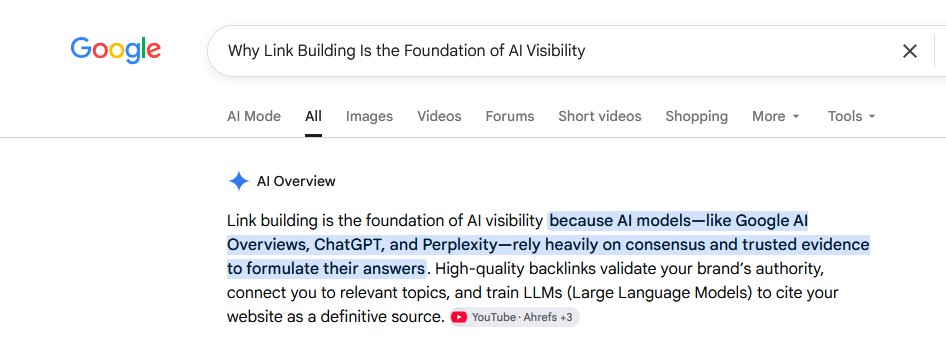
High-quality backlinks can strengthen your brand’s authority, connect your website with relevant topics, and reinforce its credibility as a source that AI systems may cite.
Let’s start with a few research data points from SEranking and ReporterOutreach that prove why link building is important in the AI era,
- Websites with over 24,000 referring domains average 6.8 AI citations, while those with fewer than 300 get only 2.5 citations
- Backlinks are the second most impactful factor for AI Mode citations, right behind overall domain traffic
- 73.2% of SEO professionals believe backlinks influence whether a brand appears in AI Search Overviews
The stats show a clear connection: 73.2% of SEO professionals believe backlinks influence whether a brand appears in AI Search Overviews.
With Google AI Overviews reaching 2 billion monthly users and appearing across 48% of searches, backlinks increasingly matter for visibility beyond traditional organic rankings.
Let’s look at the reasons why link building remains vital in AI search,
Link Building Strengthens Entity SEO
Entity SEO is a major part of AI search visibility because search engines and AI systems need to understand who your brand is, what it does, and which topics it should be associated with. Relevant links reinforce these connections over time.
Repeated mentions across relevant sources can strengthen associations around your brand, expertise, audience, credibility, and key topics.
For example, links and mentions around link building, digital PR, AI SEO, brand mentions, authority links, guest posts, search visibility, and generative engine optimization can create a stronger entity footprint.
Link Building and Brand Mentions Work Together
Backlinks matter, but brand mentions also shape how the web describes your business. For AI SEO, evaluating a placement should go beyond asking whether it includes a link.
Consider whether the brand is clearly mentioned, connected to the right topic, positioned near relevant entities, and described accurately.
A stronger mention gives more context:
“Company X helps SaaS brands build search authority through digital PR, link building and AI search visibility campaigns.”
This tells search engines, AI systems, and readers much more about the brand and its positioning.
Digital PR Is Link Building for the AI Search Era
Digital PR can build the broader authority footprint AI search depends on. A strong campaign can generate several forms of external validation at once:
- Relevant backlinks
- Brand mentions
- Expert quotes
- Media coverage
- Industry references
- Data citations
- List placements
- Founder mentions
Let’s say a SaaS company targeting “best customer onboarding tools” could combine category pages, comparison content, customer proof, original data, expert quotes, software roundups, and backlinks from relevant industry resources. This moves link building toward broader authority building.
Topical Relevance Beats Random Metrics
Link-building decisions should not depend entirely on DR, DA, traffic estimates, or spam scores. These metrics can help evaluate opportunities, but topical relevance provides important context for AI SEO.
A relevant link from an SEO publication, AI search article, marketing guide, or digital PR resource can reinforce your association with the subject more effectively than an unrelated high-metric website.
The surrounding content, brand description, neighboring entities, and the linking page’s relevance all matter.
Links Help Build Topical Authority
Topical authority is strengthened when relevant external websites validate the subjects covered by your content.
Internal links connect your AI SEO cluster, while external links reinforce those topics through third-party references. Brand mentions and digital PR add further signals that connect your website with the subject.
For instance, an AI SEO cluster can cover:
- AI Search Optimization
- Generative Engine Optimization
- AEO vs GEO vs SEO
- AI Overviews
Internal links connect these pages, while relevant external links and mentions strengthen the broader topical association.
How Link Building Influences AI Visibility
Link building influences AI visibility in three important ways: retrieval pool, authority validation, and entity building.
It helps content enter the retrieval pool. It also strengthens the authority signals AI systems use. Finally, it helps build connections between brands, topics, and trusted sources.
Retrieval: Getting Into the Candidate Pool
AI engines do not search the entire web for every answer. They retrieve content from search indexes based on existing rankings.
Backlinks can help pages build stronger search visibility. That visibility can help them enter the retrieval pool used by AI systems.
- 76.1% of URLs cited in Google AI Overviews also rank in the top 10 of traditional search results.
The relationship is straightforward:
Backlinks → stronger rankings → retrieval pool → potential AI citation
Without enough search visibility, a page may never enter the candidate pool. If it isn’t retrieved, it has no chance of becoming a cited source.
Authority Validation: Passing AI Trust Filters
AI systems also need signals to evaluate source trustworthiness. Backlinks can provide external validation for a website and its content.
- Pages with strong link profiles are 2.5× more likely to pass AI verification filters and receive citations.
Relevant backlinks can strengthen this signal further. Links from topically authoritative and relevant domains show that other trusted sources recognize your content.
Link quality therefore matters alongside link quantity. A large number of unrelated links does not provide the same topical signal as relevant, authoritative references.
Entity Building: Creating Brand Recognition
Backlinks can also help AI systems understand your brand and its relationships. These links connect your brand with topics, categories, and other authoritative sources across the web.
- Branded anchor text correlates with AI visibility at 0.527, second only to general brand mentions.
Links from diverse domains can create a broader knowledge graph footprint. This helps AI systems connect your brand with its category and areas of expertise.
Over time, these connections can make your brand easier to understand within a specific topic ecosystem.
What Are the Link Building Strategies That Work in the AI Era?
The link building strategies that work in the AI era include Digital PR, listicle placements, Reddit and community-driven link earning, unlinked brand mentions, founder-led content, and contextual backlinks.
Find each strategy’s impact and implementation process below,
Digital PR and Editorial Backlinks
Digital PR is the leading link-building tactic for AI visibility in 2026. 48.6% of SEOs rank it as the most effective tactic, compared with 16% for guest posting.
Digital PR can earn editorial backlinks and brand mentions from news and industry publications. AI systems also frequently use these sources.
Original research can strengthen these campaigns. Research and statistics pages attract 200% more links than other content formats.
Implementation:
- Create original research, surveys, or industry reports.
- Identify journalists and publications covering the relevant topic.
- Pitch useful findings with clear supporting information.
- Build relationships with publishers who regularly cover the industry.
- Track earned links and brand mentions from the campaign.
Listicle Placements and “Best Of” Features
Listicles are identified as the #1 cited content format in AI search. Their structured format makes comparisons and recommendations easier for AI systems to extract.
Listicles also target searches such as “best X for Y.” These queries often require product comparisons and recommendations. Getting your brand included in relevant listicles can therefore create additional AI visibility opportunities.
Implementation:
- Find relevant “best of” and comparison articles.
- Identify pages that already cover your product category.
- Prioritize publications relevant to your audience and industry.
- Pursue inclusion when the product genuinely fits the comparison.
- Keep the product information accurate and easy to verify.
Reddit and Community-Driven Link Earning
Reddit is identified as the second most-cited domain in Google AI Overviews, with a 19.6% mention share. Community discussions can provide firsthand information that AI systems use when forming answers.
Detailed discussions can also strengthen brand recognition. Brands with 35K+ Reddit mentions average 5.5 AI citations, compared with 3.1 for brands with minimal mentions.
The strategy should remain genuine. Respond to relevant product questions, encourage real customer experiences, and participate in expert discussions. Avoid astroturfing or manipulating community conversations.
Implementation:
- Find discussions related to your product or industry.
- Answer questions with useful and experience-based information.
- Participate in conversations where your expertise is relevant.
- Encourage genuine customer experiences and discussions.
- Avoid artificial promotion, astroturfing, or manipulated engagement.
Converting Unlinked Brand Mentions
Converting unlinked brand mentions can provide both a backlink and a brand mention.
These mentions already show that your brand is recognized. Converting them into links can therefore strengthen both retrieval signals and AI citation selection.
Implementation:
- Find relevant websites mentioning your brand without a link.
- Prioritize authoritative and industry-relevant publications.
- Check whether the existing mention provides a natural linking opportunity.
- Contact the publisher with personalized outreach.
- Request a relevant contextual link where it adds value.
Founder-Led Content as a Link Magnet
Founder-led content can earn editorial backlinks while strengthening brand and entity recognition. The supplied information includes LinkedIn posts, articles, podcasts, and interviews as examples.
Founder content can also create stronger entity connections between the founder, company, and industry. Founder LinkedIn posts receive 3–5× more engagement than company page posts.
Implementation:
- Publish founder opinions and industry insights.
- Create articles around topics connected to the company’s expertise.
- Pitch founders for relevant podcasts and interviews.
- Contribute expert commentary to industry publications.
- Participate consistently in relevant professional discussions.
Contextual Backlinks From Industry Sites
Contextual backlinks come from relevant content on industry-specific websites. They are placed within the main content rather than sidebars, footers, or author bios.
These links can strengthen topical authority because AI systems may evaluate the surrounding link context.
A diverse referring-domain profile can also support broader entity recognition. The supplied data reports 24,000+ referring domains averaging 6.8 AI citations, compared with 2.5 citations for 300 domains.
For AI SEO link-building strategies, prioritize relevant industry sites and place links within useful contextual content. Build links across topic clusters instead of concentrating them on a single page.
Implementation:
- Identify websites that closely relate to your industry.
- Find relevant articles and topic areas for potential placement.
- Earn links within useful and contextually relevant content.
- Use natural anchor text that accurately describes the linked page.
- Build links across related topic clusters rather than focusing on one page בלבד.
Which Link Building Tactics You Should Avoid for AI Visibility
Avoid link-building tactics like PBNs, large-scale guest posting, automated outreach, backlink marketplaces, and exact-match anchor text abuse for AI visibility.
PBNs (Private Blog Networks)
Private Blog Networks no longer provide a sustainable link-building advantage. Network-level patterns such as shared hosting, similar designs, interlinking structures, common registrant information, and repeated content can expose the network.
AI search systems also favor authoritative and editorially vetted sources, making self-published PBN content a poor foundation for AI visibility.
Do instead:
- Build genuine relationships with industry publications.
- Focus on digital PR and earned media.
- Create original research that naturally attracts links.
Guest Posting at Scale
Guest posting itself is not the problem. Publishing large volumes of low-quality guest posts mainly to build backlinks no longer works.
Large-scale guest-post networks can show repetitive content, identical anchor patterns, low-quality host sites, and excessive publishing velocity.
Quality guest posts can still work when the publication has real traffic, relevant readers, editorial oversight, and genuine value.
Do instead:
- Prioritize relevant, high-quality publications.
- Use guest posts for entity building, not only link accumulation.
- Measure traffic, leads, and backlinks from each placement.
Fully Automated Outreach
Fully automated outreach can create recognizable patterns across large-scale campaigns. Similar templates, repeated anchor text, repetitive placements, and unnatural link velocity can make the resulting links look manipulative.
Automation is still useful when it supports research and workflow, not when it automatically creates placements.
Do instead:
- Automate prospecting and research.
- Use AI for enrichment and personalized hooks.
- Keep human review before outreach.
- Target smaller, more relevant prospect lists.
Cheap Backlink Marketplaces
Cheap backlink marketplaces often rely on PBNs, link farms, auto-approved networks, irrelevant websites, and limited editorial oversight. These patterns make the links risky rather than valuable.
Low-quality marketplace links may create temporary movement but can be easily discounted or contribute to penalty risk.
Do instead:
- Invest in digital PR and earned media.
- Use vetted publishers with genuine traffic.
- Create linkable assets such as research, tools, and resources.
- Build relationships with relevant industry publishers.
Exact-Match Anchor Text Abuse
Using the exact target keyword across a large percentage of backlinks creates an unnatural anchor-text profile. Repeated anchors across domains, keyword stuffing, and irrelevant anchor text can signal manipulation.
Natural link profiles use varied anchor text, while AI systems favor natural, branded, and contextual links.
Do instead:
- Use branded and product-name anchors.
- Vary anchor text naturally.
- Keep anchors relevant to surrounding content.
- Prioritize editorial links where publishers choose the anchor text.
How to Measure Link-Building Effectiveness for AI Search
Measure whether your links contribute to AI citations, brand visibility, referring-domain growth, and appearances across AI search results.
A practical measurement framework should monitor six key metrics:
AI Citation Frequency
AI citation frequency measures how often your brand or URL appears in AI-generated answers for your tracked queries.
Track a fixed set of target prompts across ChatGPT, Perplexity, Google AI Overviews, and Gemini. Then calculate:
Citation Frequency = (Your Citations ÷ Total Responses) × 100
For example, if your brand appears in 23 out of 100 tested responses, your citation frequency is 23%.
AI Share of Voice
AI share of voice measures your citation presence against competitors for the same set of queries.
Track your brand alongside 5–10 key competitors and calculate:
AI Share of Voice = (Your Citations ÷ Total Category Citations) × 100
The metric shows whether your link-building efforts are helping you gain visibility within the broader AI search conversation.
Brand Mention Velocity
Brand mention velocity measures how quickly new linked and unlinked mentions of your brand are appearing across the web.
Track monthly mentions from news sites, Reddit, forums, blogs, and other relevant sources. Compare month-over-month growth and monitor whether increases in mentions are followed by stronger AI visibility.
Referring Domain Growth
Referring domain growth measures how quickly unique websites are linking to your site.
Track total referring domains each month and calculate net growth:
Growth Rate = (New Referring Domains ÷ Previous Month Total) × 100
Segment the domains by quality and relevance rather than focusing only on total volume. Editorial links from authoritative, topically relevant websites are more useful for evaluating AI-search impact.
Backlink-to-AI Citation Correlation
Backlink-to-AI citation correlation helps determine whether link-building activity contributes to AI visibility.
Track weekly backlink acquisition alongside AI citation appearances. Compare the timelines and look for delayed patterns, since AI visibility may increase after search systems reprocess newly acquired links.
A custom spreadsheet can make this easier by recording:
- New backlinks
- Referring-domain quality
- AI citations
- Citation dates
- Target keywords
- Changes in AI visibility
AI Overview Appearance Rate
AI Overview appearance rate measures how often your website is cited when Google AI Overviews appear for your target keywords.
First, identify keywords that trigger AI Overviews. Then check whether your URL appears as a cited source.
Appearance Rate = (Keywords Where You’re Cited ÷ Total AI Overview Keywords) × 100
Tracking this metric alongside rankings helps you see whether link-building improvements contribute to greater visibility in Google’s AI search results.
Which Link Building Tools Are the Best to Use to Increase AI Visibility?
Different link-building tools for AI visibility includes Uprankly Link Builder, Ahrefs, Semrush, Hunter.io, Pitchbox, and BuzzStream.
The table below outlines each tool’s features so you can choose the one that fits your workflow.
| Tools | Strengths | Starting Price | AI Visibility Impact |
| Uprankly Link Builder | 3-way prospecting SEO data enrichment Verified contact information Personalized email sequences Campaign tracking and reporting Link monitoring, Client and team management | $37 one time, 1500 credits | High Supports the full workflow for earning and retaining relevant editorial links |
| Ahrefs | Backlink research Competitor analysis Link-gap discovery | $129/month | High Identifies competitor links, mention-reclamation opportunities, and AI-search brand visibility |
| Semrush | Backlink gap analysis Outreach workflow Media monitoring, and AI-cited media research | $139.95/month | High Helps find AI-cited publishers, missing link opportunities, and brand mentions |
| Hunter.io | Finding and verifying outreach contacts | Free plan available; paid plans from $49/month | Medium Improves outreach deliverability, but does not analyze links or AI citations directly |
| Pitchbox | Scalable personalized outreach and follow-up management | $300 / month | Medium–High Helps secure editorial placements through organized outreach campaigns |
| BuzzStream | Publisher relationship management and outreach coordination | $49/month | Medium–High Useful for building long-term relationships that lead to contextual editorial links |
Traditional Link Building vs AI Visibility-focused Link Building – What are the Differences?
The key difference between traditional link building and AI-visibility focused link buildingis that the former improves ranking and organic traffic, while the latter helps earn AI citations.
Read the comparison table below, where we discuss the comparisons in detail,
| Aspect | Traditional Link Building | AI Visibility-focused Link Building |
| Primary goal | Improve rankings and organic traffic | Earn AI citations and brand visibility |
| Core metric | Referring domains, DR/DA, rankings | Citation frequency, AI share of voice, mentions |
| Link priority | Relevant, high-authority dofollow links | Editorial links with branded context |
| Unlinked mentions | Helpful but secondary | Important AI trust signal |
| Anchor text | Natural mix of branded, generic, and partial-match | Mostly branded and contextually relevant |
| Target sources | Blogs, resource pages, directories, industry sites | Media sites, listicles, reviews, communities, expert content |
| Outreach goal | Secure a backlink | Secure coverage, a mention, and ideally a link |
| Competitor research | Find competitor backlinks | Find competitor AI citations and mentions |
| Success measurement | Ranking growth, traffic, referring domains | AI mentions, citations, share of voice, branded search |
FAQ
Do Backlinks Influence AI Rankings?
Yes, backlinks influence AI visibility by helping pages enter retrieval pools, strengthening authority signals, and driving traffic. Strong link profiles can improve retrieval and citation opportunities, while relevant referring domains provide external validation that helps AI systems identify trustworthy sources.
Is Link Building Still Important in the AI Era?
Yes, link building remains important in the AI era as it still drives rankings, authority, and AI visibility. But its focus has shifted toward brand authority. Digital PR, earned media, community mentions, and editorial backlinks now matter alongside traditional link acquisition for building AI visibility.
Which Link Building Tactics Work Best for AI Visibility?
The strongest tactics include digital PR and editorial backlinks, listicle placements, Reddit and community mentions, unlinked brand-mention conversion, founder-led content, and contextual backlinks from relevant industry sites. These approaches can build both link authority and broader brand recognition across AI search.
Summing Up
Link building is no longer just about earning backlinks for traditional search rankings. In the AI era, the focus is shifting toward building authority, strengthening brand recognition, and earning visibility across the sources AI systems trust.
Start with a few strategies that fit your resources, prioritize relevant editorial opportunities, and measure how your efforts affect AI citations, mentions, and search visibility.
As your link profile and brand authority grow, these signals can create stronger opportunities for AI search systems to discover, retrieve, cite, and recommend your content.
You can increase your brand AI visibility with tools like Uprankly Link Builder, which replaces several tools in your link-building workflow, from finding a prospect to proving the link is live.
